
A 2025 Reading Log
My year in (the) books
Happy 2026! I’m fighting the Sunday Scaries before my semester begins on Wednesday by making good on my new year’s resolution: writing to you here, monthly.
January is theoretically a month of new beginnings, but I usually find it to be a contemplative month to look back instead. December is just too busy a month to allow for the reflection the end of year deserves. I usually try to make a list of highlights of my year for my birthday, sometimes I round up my favorite pictures of the past twelve months. Last year I even made an EOY presentation with charts and all, and insisted my girlfriends make one, too. But this year, the only list I’ve really finished putting together is my book list.
So for you today, a list of my favorite reads. This is less an analysis of the content of these books, and more an unpacking of the place each took in my year, in my reading diet. I shared this list on Instagram already (as the true fans will have seen) and I’ve definitely talked about these books a lot (as the true friends will have heard), but I wanted to sit with this list a bit longer.
A good book is a good companion at a given moment in time. These were my favorite companions at notable moments this year.
Best fiction reads of 2025:
Margo’s Got Money Troubles by Rupi Thorpe
This book, oh my god this book. If we’ve talked recently, I’ve definitely told you about this one. It rewired my brain chemistry, as they say. By which I mean it showed me a whole new way a novel can operate.
My professor Julia Philips put this on our syllabus and told us it was her favorite book of 2024. I took one look at the cover and rolled my eyes, but as soon as I opened it I realized I had misjudged it. The first paragraph is addressed directly to the reader, and then it takes off running from there, in both 1st and 3rd person narration. I raced through my copy, which I’d borrowed from my library, and canceled plans on a Friday night to read in bed. I had 100 pages to go and was leaving for Boston the next day and I couldn’t put Margo down. I ended up finishing the book on the train, reading on my phone. I’d pause between chapters to stare out the window, to journal, to text my friends who were reading it screenshots of the pages, to tell those who weren’t to hurry up and get started. At key turning points, I reacted audibly enough for the person across the aisle to glance my way. I arrived to my destination, to my friend Emma, nearly delirious from my time in Margo’s world.
The odd thing about reading on your phone is you don’t know when you’re approaching the end. There’s no weight of the pages in your hands to inform you about how much more of the story is ahead of you, there’s no flipping to the end to check. There’s no progress bar on the app I was using, at least. So I got to the ending not thinking it was the end, not wanting it to be over. It’s one of those endings that is more of an opening onto what’s next than a closing up of what’s come before. And for Margo, that was all I could hope for. For more to come.
I’ve been workshopping this metaphor to describe the novel: it’s packaged like junk food, and it tastes as good as your favorite calorific snack, but actually it’s a super healthy green juice filled with nutrients. A.k.a.: it’s the best of both worlds.
Audition by Katie Kitamura
This book is the book I talked about the most this year, the book I made all my friends read. Largely because it’s absolutely confusing, and I needed to hear everyone else’s opinions and interpretations.
Katie Kitamura is a master of a particular kind of novel: deep 1st person interiority, complex female protagonist, small cast of characters, sparse prose. She came to teach a master class on campus two years ago, and I’d read and loved her novel Intimacies ahead of that. Her class, craft talk, and reading were all exceptional. And then a year later, I was at an event at 192 Books, and Kitamura was there, too, two rows ahead of me, her black hair draping elegantly over her shoulder. She turned around and recognized me, which already delighted me. On the way out, we chatted briefly about the event and the past year, and so of course I love her a lot.
So I was very excited to hear she had a new novel coming out. I borrowed an advanced copy of Audition from my friend who used to work at Penguin, and seriously wondered if this uncorrected proof had an error in it when I arrived to the middle. But the error went on to become the whole second half, and I read in a state of befuddlement and fascination. A novel can do that?? Can twist the key relationship on it’s head, can explicitly contradict itself? I was perplexed, but I was reading it before the book had been released, so I couldn’t ask for or read any explanation.
Months later, when I went to see Kitamura discuss the novel at the Brooklyn Public Library with Juliette, I got to ask my question: “How can you trust the reader to follow you through that twist in the middle, to hold on to the narrative enough to bridge that chasm?” She was so graceful as a speaker. She talked about the two halves of her book side by side making meaning together. Her answer to my question, in short: “The reader is very smart and you have to trust them to be smarter than you are.” I don’t know if I am. I’ll have to re-read this one. I’m still thinking about it.
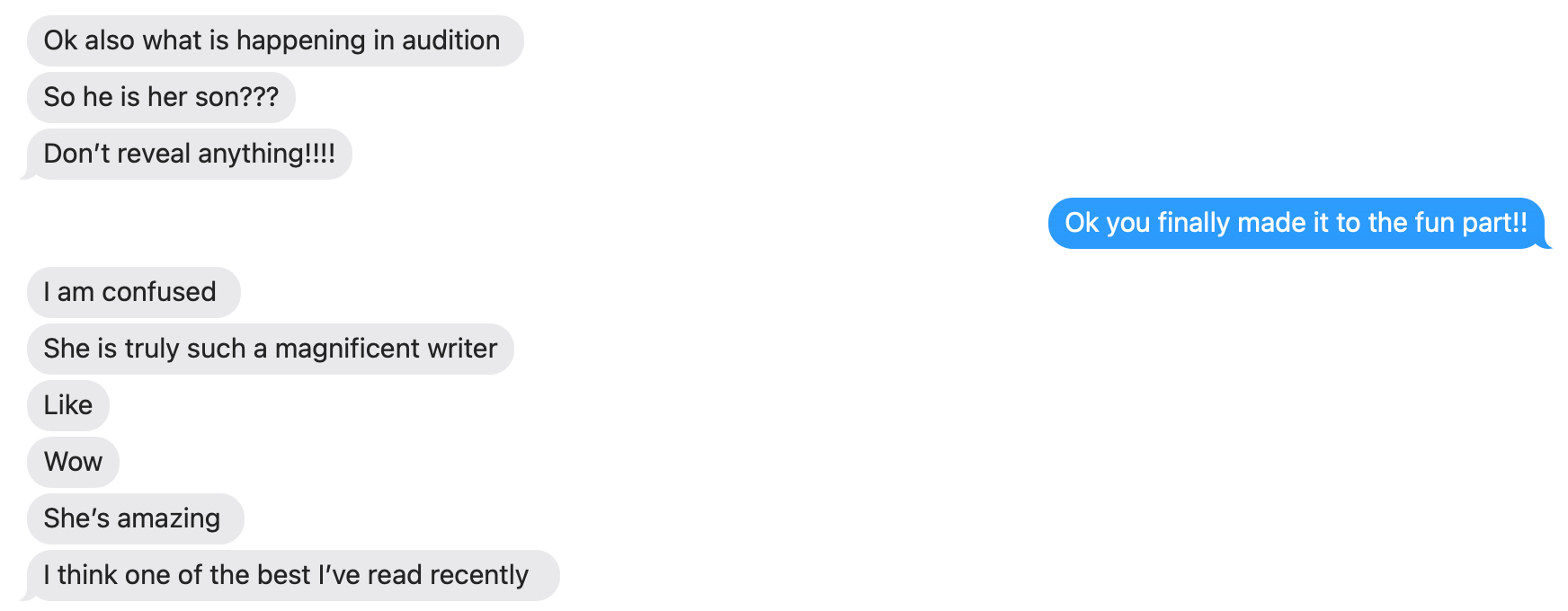
(an appropriate reaction from my friend Lucy half way through the novel)
Headshot by Rita Bullwinkel
This is the book that grew on me the most. Another assigned reading from my class with Julia Philips, another surprise. On it’s face, it’s a novel about teen girl boxers - not a topic I thought I’d enjoy. But it’s so much less about the boxing and so much more about each teen girl’s particular state of mind as she boxes. Written in an incredibly close 3rd person, the narrative doesn’t leave the boxing ring except for in memories and in a brief flash forward to a future where teen girls box on Mars. Weird, right? And delightfully so.
As for what place this novel took in my year? I attended the Association of Writers & Writing Programs in the spring for work, and the panel I was most excited to attend featured the author of my favorite short story. Also on the panel, Rita Bullwinkel, who read a snippet from this novel, and (all love to Kate Folk, author of Out There) she stole the show. So it was fun to find her novel on my syllabus two seasons later and feel like I’d gotten a sneak preview.
(Bullwinkel is also the editor of McSweeny’s, and I used to work at 826 Valencia, both of which were founded by the same person, and that doesn’t mean I’m connected to Bullwinkel at all in any meaningful way, it’s just a fun fact that sometimes I play up for the heck of it when I’m trying to tell myself I’m more in touch with the literary scene than I really am.)
The Neapolitan Quartet by Elena Ferrante, translated by Ann Goldstein
I’m listing these four novels as one because I think their magic works best when you consider them as a unit. The end of The Story of the Lost Child ties to the beginning of My Brilliant Friend in a masterful way, one that must have taken the kind of careful planning and organic spontaneity authors and my professors love to talk about.
These are the books that carried me through the summer. I read this quartet in New York, on my couch, on my roof, on the subway, at the park, by the pool. I read them in France, on the train, in the car, in my garden, at the river. I read them in California, in bed at my parents and at friend’s houses. And all the while, they took me to Italy. The most basic and boring take on these brilliant novels: they transport you to Naples of the 1950s and immerse you in the protagonist’s life there. And isn’t that what we’re looking for when we read? A book to take with us everywhere we go, a book that takes us somewhere else entirely.
Another thing that made these so fun: So many people around me had already read them, or were beginning to read them, so I could discuss all the twists and turns (of plot and of sentences) as I went. The best part of reading a series is reading it with your friends, which is half of why we all loved Twilight and The Hunger Games so much. I borrowed the first in the quartet from El, passed it to Juliette when I was done, as I would have at 13. And that shared feeling is what I’m always looking for when I read.
Women Talking by Miriam Toews
I can’t think of my year of reading and not think of this novel, even though I first read it in 2021. I spent a lot of time with this magnificent, nearly perfect novel this year, and it affirmed its place high up on my list all time favorites.
This summer, I packed up all my books and put them in storage for two weeks between moving out of my old apartment and moving into my new apartment. In the interim, I had nothing to read. A minor tragedy. Until I crashed at Juliette’s and she returned my copy of Women Talking, the one I’d let her ages ago after having loved it the first time around. So I re-read it while bouncing around Brooklyn and finished it right after moving into my new place in June. I was eager to rediscover what I had so loved about it, and was surprised to find I had no memory of the ending. My reading experience was just as suspenseful, just as affecting as the first time around.
And then in late August, I got my syllabus for the semester, and this was the second novel on the list. My professor Julia Phillips and I agree that it’s perfect, and it was special to get to examine, to explicate its power in class. She nearly cried twice, or maybe did cry, while discussing this novel. And I don’t know how many times I’ve cried reading it.
And the same week we discussed the novel in class, I again went to the Brooklyn Public Library with Juliette to hear a favorite author discuss a new book. Toews was there to discuss her new memoir, but she also talked a bit about her other books. She was endearingly shy on stage, stuttering her way through sincere, surprising answers. In response to an audience question, she revealed that some of the characters in Women Talking are based on her sister, her father, and her. This reveal felt like being given a key to the author’s home city. After, at the signing table, I brought Toews my re-read, dog-eared copy, and tried to communicate to her my admiration for her writing. She thanked me, and signed it for ‘Clio’, and I was too shy to correct her spelling. It’s okay, it’s still a favorite and now prized book on my shelf.
Best nonfiction reads of 2025:
Teaching a Stone to Talk: Expeditions and Encounters by Annie Dillard
At the beginning of the year, I wrote an essay about witnessing the total eclipse of the sun, which I open with a quote from Annie Dillard’s essay Total Eclipse. I had read the essay a long time ago, who knows when, and I’d been thinking of it a lot while planning for and then witnessing said total eclipse. But I didn’t fully reread her essay until I started writing my own. I brought the first draft to my professor Heather Harpham, and the following week she brought me her own copy of Teaching a Stone to Talk. Inscribed on the first page, a dedication from her childhood best friend, dated Christmas 1999.
I made my way slowly through the collection through the winter and into the spring, my companion through a semester of nonfiction work. I loved her unusual topics, her very particular style. Annie Dillard taught me that nonfiction can also be totally made up at times. And for that I thank her. And for the generous loan, and teaching me lots about nonfiction all year long, I thank Heather.
Meander, Spiral, Explode: Design and Pattern in Narrative by Jane Alison
I read the foreword of this craft book for homework for Heather’s class while seated on my friend’s couch, and I had to pause to read paragraphs aloud to her. When the spring semester ended, I bought myself a copy at my favorite bookstore, and told myself it was going to be my summer reading homework. I didn’t get around to opening it until October, when the other craft book I was assigned for class was driving me crazy with its heavy-handed prescriptive formulas about how to write a ‘great’ novel. Enough with the emphasis on character arcs and desires, I needed something fresh. This book was a perfect antidote. Highly recommend if you want to pull apart sentences down to their bones.
Grief Is For People by Sloane Crosley
I brought this book with me on Thanksgiving break after having heard Sloane Crosley read from it on campus. I’d spent the flight over to Michigan reading my friend’s manuscript, and so I only cracked this open once I’d arrived to my aunt Hilary’s. I read from it aloud to her before bed, and then in her office the next day while she edited photos. Crosley’s reading had reminded me that reading something aloud can give it so much more life. Reading it to my aunt reminded me how special it is to share a text like this. And these sentences - crisp and sharp and short - were a delight to read aloud.
When we went to my favorite bookstore in Ann Arbor (the place I pretty much decided to apply to MFAs), Hilary got herself a copy so that we could keep reading it side by side now, so that I could tear ahead. She didn’t realize it was nonfiction til we pulled it off the shelf; something about that feels like proof that it’s the best kind of nonfiction. The kind you barely believe is real.
The Book of Delights: Essays by Ross Gay
I mean of course this book is a delight, by definition. I felt like I knew this book so well before ever opening it. I’d heard Ross Gay be interviewed about it when it came out. Friends have read it, told me about it, started running their own lists of delights. I’d read essays from the collection in at least two classes, if not three. But I hadn’t held the actual book in my hands till I found a copy in a little free library on a walk (a delight, always). Then it sat on my bedside table all fall. I’d read an essay or two on nights when I wasn’t actively reading something else. Or when I was procrastinating writing, or just at random as a dose of joy and good prose. It’s a perfect book to pick up and put down at will. I dog-eared so many essays, but I passed my copy along to my mom at Christmas. If I need to check on those bookmarked essays, I’ll have to have her read them aloud to me.
Bonus: The Möbius Book by Catherine Lacey - my last read of the year
I closed out the year with this hybrid book, per a recommendation from a trusted writing friend. It’s half fiction and half nonfiction, and meets in the middle like a Möbius strip. As someone who sits right on that line between genres, I was so curious to see how this would work. As someone who’s writing a hybrid collection of essays and stories, I needed to find out how it was executed.
Does it work? I’m not too sure. It is well executed, but it risks being too crafted, too intentionally clever. I devoured my way through the nonfiction in a day and a half in a quiet moment after Christmas, sitting in the Santa Cruz sun and laying in bed in a darling guest bedroom with view onto a cypress tree. A delightful reading experience, the best of its kind. The fiction half, however, falls a bit flat in comparison. While it pulls from the nonfiction in interesting ways, it’s almost too much of a reveal of the author’s creative process, of the way we all borrow from nonfiction when writing fiction. Sometimes, that’s a secret better kept off the page…
And there you have it, my top 10 books of 2025, a third of my reading life for the year. Thanks for reading this far in what turned out to be a very long reflection on the past twelve months through books.
As the year closed, I read through a handful of other people’s 2025 reading lists, usually much longer than this. I read through many Best Of lists, filled with titled I hadn’t heard of. Someone at a Halloween party, dressed up as a ‘book jacket’, invited me to join their bookclub that reads 60 books in a year. And a friend sent me his friend’s book list, so filled with titles he must average a book every three days. I admit to feeling intimated by long lists like that, to briefly feeling like my reading diet isn’t rich and vast enough. But I read more books this year than in any since I’ve started tracking, and I learned something from each of them. I’m content with this reading life of mine.
I started off 2026 by finally reading Bel Canto by Ann Patchett, a novel that will very likely make my end of year list. But who knows what my reading list ahead holds - and the surprising discoveries, and sharing them with friends, are the funnest part.